What Is the Relationship Between Grace Art and Salvation
Discipleship: Four Major Worldviews
This commodity presents a summary of four worldviews that are prominent in the world today. A "worldview" is a way of thinking about truth and reality. It sums up the basic conclusions about life and meaning that a person figures out and lives by, either consciously or unconsciously. James Sire, inThe Universe Side by side Door ,gives the following definition of "worldview":
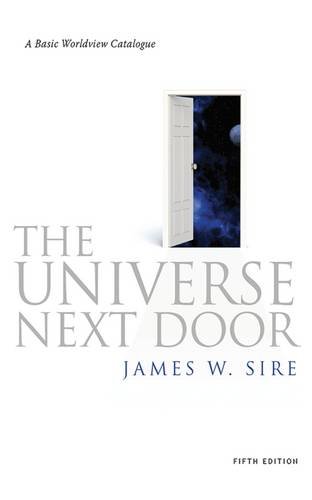
A earth view is a set of presuppositions (assumptions which may exist truthful, partially truthful or entirely simulated) which we hold (consciously or subconsciously, consistently or inconsistently) nearly the basic make-up of our earth. Or we could but say it is the sum total of what we believe about the almost of import issues of life.
Sire suggests the post-obit vii questions nosotros can inquire ourselves in determining our own particular worldview. In summary, they are as follows:
- What is prime reality—the really existent?To this we might reply: God, the gods, or the material universe.
- Whatisthe nature of external reality, that is, the world around us?Do nosotros see the globe as created or autonomous, as chaotic or orderly, as matter or spirit? Do we emphasise our subjective, personal relationship to the world or its objectivity apart from u.s.?
- What is a human being?Are nosotros highly complex machines, sleeping gods, people made in the paradigm of God, or "naked apes"?
- What happens to a person at decease?Is it personal extinction, transformation to a college state, or difference to a shadowy beingness on "the other side"?
- Why is it possible to know annihilation at all?Sample answers include the idea that we are made in the epitome of an all-knowing God or that consciousness and intelligence have developed under the pressures of survival in a long procedure of development.
- How do we know what is right and wrong?Is it considering we are made in the paradigm of God whose character is good? Are right and wrong adamant by man option alone? Or accept the notions just developed under the pressures of cultural and physical survival?
- What is the pregnant of homo history?Is it to realise the purposes of God or the gods, to brand a paradise on earth, to prepare people for a life in community with a loving and holy God, or something else?
Any answers nosotros requite to such questions will manifestly have a big effect on such matters equally our goals in life—how we brand decisions; the manner we treat other people; the style we value ourselves; our attitude to fabric possessions; the way nosotros confront death; what we remember is incorrect with the world and how nosotros are going to put it right; how we relate to homo need, to family structure, to those outside our own customs, to homo rights, or to government. Though recognising that what wesaynosotros believe and hownosotros conductexercise not always lucifer upwards, our actions often signal clearly to what wereallybelieve.
With these questions in heed, let'due south have a brief look at what are perhaps the four major worldviews that people agree in the modern world. It is important to note that the following summaries are extremely brief and you may well remember simplistic. Certainly we could find variations on each of them. Notwithstanding, they are given in order to underline the fact that these worldviews are different and that the differences cannot but affect the fashion we live. Some people option $.25 that appeal to them from two or more of these worldviews and end upwards with a hodgepodge of beliefs, just this is ordinarily the result of not thinking securely enough well-nigh the problems. If, indeed, one of them should be true and the others false, so which one we cull to go with cannot but have important consequences, both for the nowadays and the future.
Samuel Johnson, the essayist and dictionary-maker of the eighteenth century, said: "Truth, sir, is a cow; which, when skeptics accept found it will give them no more than milk, they accept gone off to milk the bull." But milking the balderdash is non only futile. It can be positively unsafe to ane's wellness!
i. Atheistic materialism
This worldview is a relative newcomer to the historical scene in any significant measure, merely now appears to be in decline. Statistician David Barrett says that since 1970 the number of atheists has dropped from four.6% of world population to 3.8% (222 million). He predicts continuing turn down.
Reality
This fabric universe is what is actually real. As Carl Sagan, astrophysicist and populariser of science puts it, "The cosmos is all that is or all that ever will exist." The present scientific view of how the universe came into being, now taught in major universities worldwide, is that it all came into existence with a "big bang" some billions of years ago. The atheist would say this was initiated by some concrete procedure as yet unknown.
Humans
Human consciousness and intelligence developed from chemicals past a long process of adventure evolution. Personality developed from impersonal hydrogen atoms. "God is the DNA code," says Timothy Leary. We are all the products of matter, time and gamble alone.
How exercise we know things?
Knowledge is the result of physical processes in our brains. A problem here was well expressed by Professor Haldane as follows: "If my mental processes are determined wholly past the motion of atoms in my encephalon, I have no reason to suppose that my beliefs are truthful … and hence I have no reason for supposing my brain to exist composed of atoms." If my cocky-awareness, intelligence and ability to brand choices is something more than than only the movement of atoms in my brain, so, according to the materialist view, this self-awareness has somehow come about simply equally the result of physical processes.
Meaning
As there is no intelligent being who planned it all, life only has what meaning we humans choose to give information technology. Some would give it no meaning. Samuel Beckett's playBreath is a 35-2nd play that has no human being actors. The props are a pile of rubbish on the stage, lit by a fight which begins to dim, brightens (simply never fully) and and so recedes to dimness. There are no words, only a "recorded" cry opening the play, an inhaled breath, an exhaled breath and an identical "recorded" cry endmost the play. For Beckett life is such a "breath".
Death
Decease is the end of our personal existence—blotto! "Human destiny," Ernest Nagel confesses inNaturalism Reconsidered, "[is] an episode between two oblivions."
Morality and values
Right and wrong are just what we decide for ourselves as humans, either individually or in groups. Usually information technology is the majority decision that wins the day.
History
History has no ultimate purpose. We accept to brand the most of what we accept got. In the terminate, this planet will certainly fire upwards or freeze and that will be the end of everything.
ii. Hinduism, Buddhism and New Age thinking
In this worldview the focus tends to be on self, how we can improve ourselves, rather than on how we can know God, and better serve him and others. A typical statement from a popular New Age magazine says:
All paths pb to God. The truthful path finally becomes self- empowerment: the path of self-love. So one demonstrates that they can manifest God and no longer need to expect outside themselves for this information. They have become the path themselves.
It is simplistic to lump Hinduism and Buddhism together, but they do have certain bones beliefs in common. New Age thinking tends to be an adaption of some of these Eastern beliefs to Western civilisation.
Reality
Everything is God. We all share the aforementioned essence or "stuff" of reality, which is spirit (Hinduism—the Brahma; Buddhism—Nirvana). This philosophy of the unity of all things has been called Monism. The basic philosophy of New Age thinking has been summed up in three pithy sayings: 'All is God", 'All is ane" and 'All is well". The New Age concept of God is impersonal, usually described as Strength, Energy, Essence, Consciousness, Vibration, Principle, or Beingness.
Affair
This material world is unreal, a sort of fantasy or dream of some kind. The "realised soul" understands that this world means nothing and is of no value. Ultimately, salvation consists in escaping from matter. New Agers tend to put a little more value on this world than do Hindus and Buddhists.
Humans
We are i with God. Our unity with all reality is emphasised. Individual personality is underplayed.
Meaning
Meaning in life comes through realising who we are in our oneness with the divine spirit. In that location are no criteria for judging truthful from false religious experience. "I believe" tends to become "I feel".
How we know truth
Our significant learning comes from withdrawal from the world, looking within, getting in touch with our existent selves, the divine within. Hinduism, Buddhism and New Age share a distrust of reason. In Hinduism and Buddhism the Ultimate is unknown and unknowable. It isneti neti, 'not this, non that'.
Morality
Sin is merely ignorance of the true nature of reality. We need enlightenment, not repentance. Suffering rather than evil is seen as our major problem, and much of Hindu and Buddhist philosophy is a response to this. For some, there is no objective standard of right and wrong. As i spiritual sage from India put it, "It's non a question of whether you are expert or bad … adept and bad are relative. They are 2 sides of one coin, part of the aforementioned whole." In a similar vein, Carl Frederick wrote in Playing the Game the New Way, "You are the supreme being … there isn't whatever right or wrong." New Historic period guru Shirley Maclaine'southward philosophy, along with that of many other New Agers, could be summed up as: "If it feels adept, practise it."
Death
We die only to be reborn in a continuous cycle of rebirth-reincarnation. In our adjacent fife we will endure the consequences of our behaviour in this i—the Eastern doctrine of Karma. If we succeed in progressing in the steps of enlightenment we volition somewhen escape this cycle into Nirvana where individual personality volition exist captivated into complete oneness with Ultimate Reality, like a wave beingness absorbed back into the body of water. Much of Buddhism denies the personal nature of God. New Age thinkers tend to be a petty more optimistic about our continuous advance in this procedure than do Hindus and Buddhists.
History
Considering we are caught upwards in this abiding bike of rebirth, history has petty meaning. Eastern religion tends not to understand the earth in terms of purpose. As someone has said, in that location is "movement and change without involving the idea of purpose."
3. Postmodernism
Postmodernism is the term used by sociologists and others to depict a way of thinking that has get very pervasive in the Western earth over the last generation. It is an approach to reality that is having a pregnant issue on literature, theatre, fine art, education, psychotherapy, constabulary, science, architecture, the study of history and people's view of religion. Some significant writers who have promoted postmodernism are de Man, Geoffrey Hartman, Harold Blossom, J. Hillis Miller, Jean-Francois Lytard, Michel Foucault, Jacques Derrida and Richard Rorty. Its origins are found in the philosophies of Nietzsche, Heidegger, Marx and Freud. On some points, particularly its attitude to truth, information technology is similar to New Age thinking. As a way of thinking it tin hardly be described as a "worldview", as one of its tenets is that there is no longer any one big story that is able to brand sense of our little stories. In other words, "worldviews" are out!
Reality
We all create our ain reality. God tends to be ignored. Should he (she, it?) be, he certainly has nothing to say about what we should believe or how we should behave.
Truth and reason
There is no absolute truth. New Age guru Shirley MacLaine holds a typical postmodern perspective. InOut on a Limbshe asks David, her spiritual guide, if he believes in reincarnation. He replies, "It's true if you believe it, and that goes for anything." As Wheaton Higher professor Roger Lundin explains inThe Civilization of Interpretation,in postmodernism "all principles are preferences—and just preferences." As a result, "they are zilch merely masks for the will to power." Postmodernism is distrustful of all authority and dogmatism. It ofttimes recasts the Enlightenment's sacred cows of reason and science as tools of oppression. Feminist scholar Sandra Harding complains that science embodies a male-centred view that is "culturally coercive."
Emotions, feelings, intuition, reflection, magic, myth, and mystical experience are now centre stage. "I know" has been replaced by "I experience". In that location is a bluffing of the difference betwixt ourselves and the existent earth out in that location.
The postmodern aversion to truth is well expressed past Allan Bloom inThe Endmost of the American Mind.
The danger… is not error simply intolerance. Relativism is necessary to openness; and this is the virtue, the only virtue, which all primary education for more than than 50 years has defended itself to [instruction]. Openness—and the relativism that makes it the only plausible opinion in the face of diverse claims to truth and the various means of life and kinds of homo beings—is the great insight of our times. The truthful laic is the real danger. The written report of history and of culture teaches that all the earth was mad in the by; men ever thought they were correct, and that led to wars, persecutions, slavery, xenophobia, racism and chauvinism. The point is non to correct the mistakes and really be right; rather it is not to retrieve that you are right at all.
Sigmund Freud had described this outcome with glaring precision most ane hundred years ago:
Fundamentally, we only find what we need and but see what nosotros desire to see. We have no other possibility. Since the criterion for truth—correspondence with the external globe—is absent, it is entirely a matter of indifference what opinions we prefer. All of them are equally true and every bit fake. And no one has the rightto accuse anyone else of error.
Someone has said that we have at present moved from the conviction that everyone has a right to his own opinions, to the notion that every opinion is equally right!
A good summary of postmodern thinking is given by Os Guinness inFit Bodies, FatMinds .
Where modernism was a manifesto of homo cocky-confidence and self-congratulation, postmodernism is a confession of modesty, if non despair. There is no truth, only truths. There are no principles, only preferences. There is no grand reason, only reasons. There is no privileged civilization, only a multiple of cultures, beliefs, periods, and styles. There is no k narrative of human progress, simply countless stories of where people and their cultures are now. There is no simple reality or any chiliad objectivity of universal, detached knowledge, only a ceaseless representation of everything in terms of everything else. In sum, postmodernism … is an extreme form of relativism.
Organized religion
Postmodernism does not rule out religion as did modernism, with its emphasis on man reason. However, the religions that are approved are very different from Christianity. You may believe what you want to. Go for what makes yous feel skillful. Religion is deli manner. You cull what y'all like from what is spread in front of you lot, and put a meal together that suits your taste. There are strong links with paganism.
Morality
All moral values are relative. Each person or culture develops their own moral values. The important question is not "Is it right?" but "What will it do for me?" In that location is a strong accent on the fact that nosotros are shaped by our culture, and a consequent diminishing of personal responsibleness.
Tolerance
Tolerance of other views is one of the pillars of postmodernism. All the same, there is one group of people to whom this tolerance is not extended, those who believe truth to exist important! This intolerance is especially directed to those who think others might be wrong. Postmodern analyst Frederick Turner, for instance, inThe Future of the Gods: Notes Towards a Postmodern Organized religion,calls for tolerance and syncretism (mixing unlike religions together). Yet, in the same article he calls evangelical Christianity a "junk religion"!
Individualism
At that place is a potent emphasis on individualism. In the American court case Planned Parenthood v. Casey, in justifying the abortion license, the courtroom declared that information technology is up to each individual to make up one's mind "the concept of existence, of meaning, of the universe, and of the mystery of human being life."
History
At that place is much rewriting of history. What really happened is either unknowable or unimportant. A distressing symptom of this is seen in a survey indicating that 33% of Americans subscribed to the view that the Holocaust, the killing of six million Jews past the Nazis during Globe War Ii, may never accept happened.
William Dever, in an excellent article in Nigh Eastern Archaeology on some author'due south approach to history, and archeology in particular, says:
Such "postmodern" thinking has affected nearly all disciplines since [about] 1950, both in the natural and social sciences, to such an extent that it is now taken for granted as the reigning image.
iv. Christianity
There is one God of infinite wisdom, holiness and power, who has existed eternally. God is personal and exists within himself as three persons, Father, Son and Holy Spirit that accept always existed in a love relationship.
Affair
The universe is the creation of this God and is dependent on him for its existence. It had a beginning and, in its present form, will have an finish. Matter is real and good. God himself shared in created human nature in the person of Jesus Christ. Though God maintains the created universe, he is distinct from it. He himself is beyond space and time.
Humans
God has created humans "in his own likeness" with self-consciousness, freedom to brand choices, moral accountability, intelligence, and spiritual qualities that enable us to chronicle personally to him. [I have dealt with issues such as the creation of humans, their place in the universe and their stardom from the animal world in the bookletThe C omplementary Nature of Science and Christianity.] His want is that we should enter into the loving relationships that already exist within the persons of the divine Trinity, and enjoy fellowship with him, both in this life and through eternity. We accept messed things upwardly by our waywardness, but he has acted in Jesus Christ to restore that fellowship. More of that afterward.
Death
We be across decease, either in a relationship with God or without him, depending on choices we take made in this life. Considering the fabric cosmos matters to God, our bodies will exist resurrected at Christ'southward 2nd Coming, though in a transformed state similar to Christ'south resurrected body.
How exercise we know the nature of reality?
God has given us intelligence which he expects united states of america to use, whether in our understanding of the universe or our knowledge of him. However, our moral perversity affects our power to recall clearly, especially when it comes to truth about spiritual matters. Truth about God, the meaning of life and death, and such matters, come up to us past revelation. In other words, God reveals this truth to those apprehensive plenty to receive it.
Morality
Considering God is perfectly good, he created humans with the same qualities of moral goodness. Still, humans accept misused the freedom given them, and our moral natures have become warped. Our goodness is tainted with "sin" and this affects our relationship with God, whose justice demands the condemnation of evil.
History
God makes his purposes known in history. It is "his story". He has fabricated himself known by his actions in history and past revealing himself to chosen individuals, and peculiarly by entering the world in the person of Jesus Christ. History had a beginning and volition culminate in the return of Jesus Christ, whom he has appointed as judge of the homo race. God will ultimately create "a new heavens and a new earth" in which his people will live eternally in a loving and joyful relationship with him.
Author: Dick Tripp
Help us provide more content like this by giving today
Donate
Source: https://www.gci.org/articles/four-major-worldviews/
0 Response to "What Is the Relationship Between Grace Art and Salvation"
Post a Comment